Single-Slit Diffraction
A single narrow slit spreads light into a broad central band with faint side maxima.
About this simulation
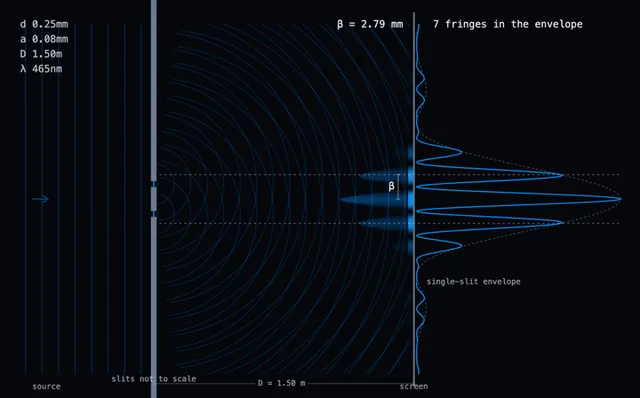
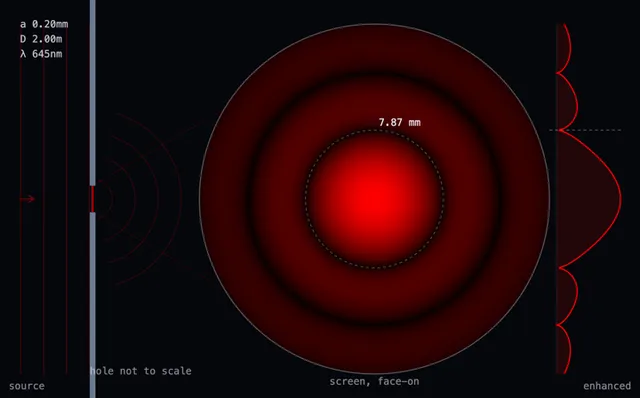
A single slit is not a point — every part of its opening re-radiates as a Huygens wavelet, and those wavelets interfere to produce a bright central band flanked by weaker side maxima. The counter-intuitive result: the narrower the slit, the wider the light spreads. Students vary the slit width a, screen distance D and wavelength λ, and can watch the wavelets superpose (Wavefronts) or the steady pattern build up (Intensity). Central band width w = 2λD/a.
How to use it
- Choose Wavefronts under Show to see plane waves reach the slit and spread out as curved wavelets; switch to Intensity for the steady pattern on the screen.
- Drag the Slit width slider down, or tap the Narrow slit preset, and watch the central band on the screen get wider — its width w is written at the top — while the dashed lines mark the first minima.
- Move the Screen distance slider and watch the dashed lines marking the first minima move apart: the band widens in millimetres with D, but the angle it spreads through does not.
- Compare the Red light and Violet presets to see that longer wavelengths diffract more.
What to notice
- The narrower the slit, the wider the central bright band: the slit width and the band width move in opposite directions.
- The central maximum is twice as wide as each side maximum, and the side maxima are much fainter, as the intensity curve beside the screen shows.
- The slit is drawn on the same millimetre scale as the screen, so you can see the light spread far wider than the gap it came through.
- The angle of the first minimum depends only on λ/a; moving the screen changes the width in millimetres, not the angle in degrees.
The formulas
- a sin θ = nλ (n = 1, 2, 3, …)
- Dark fringes occur at angles θ where the slit width a times sin θ is a whole number of wavelengths λ.
- w = 2λD / a
- Width w of the central bright band on a screen at distance D, for wavelength λ and slit width a (small angles).
- I(θ) = I₀ [sin β / β]², β = π a sin θ / λ
- Intensity at angle θ relative to the central intensity I₀.
Questions
Why does the central maximum get wider when the slit is made narrower?
The first dark fringe is where light from the two halves of the slit cancels, at a sin θ = λ. A smaller slit width a needs a larger angle θ to produce that cancelling path difference, so the dark fringes move outward and the central band widens. In the simulation, the Narrow slit preset (a = 0.08 mm) pushes the dashed first-minimum lines far apart, a band about 19.5 mm wide, while Wide slit (0.50 mm) pulls them in to about 3.1 mm.
Why is the central maximum twice as wide as the secondary maxima?
The central maximum stretches from the first minimum on one side (a sin θ = −λ) to the first minimum on the other (a sin θ = +λ), a spread of 2λ/a in angle. Each secondary maximum lies between two neighbouring minima, such as λ and 2λ, a spread of only λ/a. So, for small angles, the central band is exactly twice as wide as each side band.
What is the difference between interference and diffraction?
Interference is the superposition of waves from two or more separate coherent sources, such as two slits, and gives evenly spaced fringes of nearly equal brightness. Diffraction is the superposition of wavelets from different parts of one opening, and gives a bright central band with much fainter, narrower side maxima. Both are the same principle of superposition; the single-slit pattern in this simulation is pure diffraction.
Why do we notice diffraction of sound easily but not of light?
Diffraction is significant only when the opening is comparable to the wavelength. Sound wavelengths are about a metre, similar to doors and windows, so sound bends round them readily. Visible light has wavelengths of only 400–700 nm, so everyday openings are thousands of times too big. That is why the slit in the simulation is a fraction of a millimetre wide.