Bouncing Ball on an Incline
A ball dropped onto a slope bounces in ever-shifting parabolic hops.
About this simulation
A ball dropped onto an inclined plane rebounds again and again — each bounce a fresh projectile launch, damped by the coefficient of restitution e. Students vary the incline angle θ, drop height h and restitution e and watch how the spacing and height of successive bounces evolve. A clean way to connect projectile motion, collisions and energy loss.
How to use it
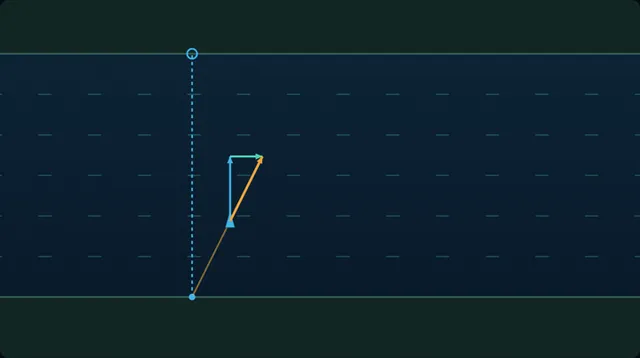
- Watch the first drop: a thin vertical line marks the drop, labelled h = 1.60 m at the defaults, and the ball meets the slope at √(2gh), about 5.6 m/s.
- Follow the trail after the first bounce: each hop is a parabola, and the blue arrow shows the ball's velocity at every instant.
- Lower the Restitution slider, or tap Dead ball (e = 0.4), and see the hops die away quickly; tap Superball (e = 0.95) for long, lively hops.
- Change the Incline angle slider, or tap Steep slope or Shallow, high drop, and compare how quickly the ball travels down the slope; the bounce count is shown at bottom right.
What to notice
- At each impact only the velocity component perpendicular to the slope is reversed and reduced by e; the component along the slope is kept.
- Between impacts the ball is an ordinary projectile, so every hop is a parabola.
- The height measured perpendicular to the slope falls to e² of its previous value each bounce, which is why each hop rises visibly less far from the slope than the one before.
- The ball keeps speeding up down the slope even while its hops above the surface shrink, because gravity has a component along the incline.
The formulas
- v = √(2gh)
- Speed v of the ball when it first hits the slope after falling a height h under gravity g.
- v′⊥ = −e · v⊥
- After impact the velocity component perpendicular to the slope reverses and is multiplied by the coefficient of restitution e.
- h⊥,next / h⊥ = e²
- Each rebound height measured perpendicular to the slope is e² times the previous one.
Questions
What does the coefficient of restitution mean when a ball bounces off a slope?
It is the ratio of the speed of separation to the speed of approach along the line of impact, e = v_separation / v_approach. For a ball hitting a fixed surface, it is the rebound normal speed divided by the incoming normal speed. e = 1 is perfectly elastic, e = 0 perfectly inelastic, and real balls lie in between. In the simulation the Restitution slider runs from 0.30 to 1.00.
What is the time of flight between two bounces on an inclined plane?
Take axes along and perpendicular to the slope. Perpendicular to it, gravity's component is g cos θ, so a ball leaving with normal speed u⊥ returns to the surface after t = 2u⊥ / (g cos θ). Since u⊥ is multiplied by e at each impact, each hop lasts e times as long as the one before. In the simulation, watch the hops get shorter in time as well as height.
For a perfectly elastic ball on an incline, how are the distances between bounces related?
With e = 1 the normal speed is the same after every bounce, so every hop takes the same time, 2v/g, where v = √(2gh). Along the slope the ball accelerates at g sin θ, so each hop covers 8h sin θ more than the previous one, and the distances are in the ratio 1 : 2 : 3 … In the simulation, set Restitution to 1.00 and watch the hops lengthen steadily.
How much kinetic energy is lost in a bounce with coefficient of restitution e?
Only the normal component of velocity is reduced, from v⊥ to e·v⊥. The kinetic energy associated with that component falls to e² of its value, so a fraction 1 − e² of it is lost as heat and sound. The along-slope kinetic energy is unchanged in this model. With e = 0.75, the default, 44% of the normal-component energy is lost at every impact.
Related simulations