Galvanic Cell — Electrode Potentials & EMF
Pick two metals and watch electrons flow, ions migrate and the voltmeter settle.
About this simulation
Two metal electrodes in their salt solutions, joined by a wire and a salt bridge. Students choose the metal for each half-cell from an activity series; the sim identifies the anode (lower standard potential, oxidation) and cathode automatically, animates electrons flowing anode → cathode through the wire and ions migrating through the salt bridge to keep each half neutral, and reports EMF = E°cathode − E°anode with the balanced half- and overall reactions and the cell notation. Swapping the beakers shows the anode/cathode roles follow the metal, not the position; picking metals far apart in the series (Mg & Ag) versus close (Fe & Ni) makes the potential gap tangible.
How to use it
- Choose a metal in 'Left half-cell' and another in 'Right half-cell'; each option shows its standard reduction potential E°.
- Read the labels under the beakers: the metal with the lower E° is marked ANODE (−) with oxidation, the other CATHODE (+) with reduction.
- Follow the yellow electrons through the wire from anode to cathode, and the coloured ions moving through the salt bridge in opposite directions.
- Try the 'Swap the sides' preset and notice the electron arrow reverses but the anode is still zinc.
- Compare the 'Widest gap' (Mg and Ag) and 'Fe & Ni — weak' presets on the voltmeter, which reads the cell EMF beneath the V.
What to notice
- The metal with the more negative standard reduction potential is oxidised and becomes the anode, whichever beaker it sits in.
- Electrons travel through the external wire from the anode to the cathode, never through the salt bridge.
- Ions move through the salt bridge to keep both solutions electrically neutral; without it the current would stop at once.
- The cell EMF depends only on how far apart the two metals are in the series: Mg–Ag gives over 3 V, Fe–Ni under 0.2 V.
The formulas
- E°cell = E°cathode − E°anode
- Standard EMF of the cell, from the standard reduction potentials of the cathode and the anode (both written as reductions).
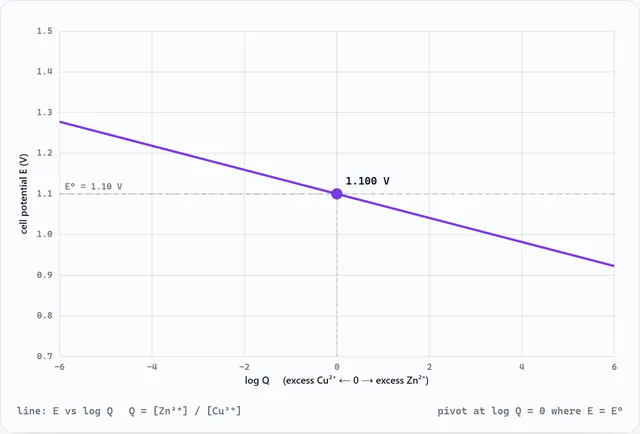
- Zn + Cu²⁺ → Zn²⁺ + Cu (E°cell = 0.34 − (−0.76) = 1.10 V)
- Overall reaction and EMF of the Daniell cell, zinc anode and copper cathode.
- Zn│Zn²⁺ ‖ Cu²⁺│Cu
- Cell notation: anode on the left, cathode on the right, single lines for phase boundaries and a double line for the salt bridge.
Questions
What is the function of a salt bridge in a galvanic cell?
The salt bridge completes the internal circuit and keeps both half-cells electrically neutral. As the anode releases positive ions and the cathode removes them, charge would build up and stop the reaction. Ions from the bridge move to cancel it: anions toward the anode, cations toward the cathode. It also stops the two solutions mixing. Watch the coloured ions moving in opposite directions through the bridge.
How do you decide which electrode is the anode in a galvanic cell?
Compare standard reduction potentials. The electrode with the lower (more negative) E° has the greater tendency to lose electrons, so it is oxidised and acts as the anode, the negative terminal. The higher-E° electrode is reduced and is the cathode, the positive terminal. In the simulation, put copper on the left and zinc on the right: zinc is still labelled the anode.
How do you calculate the EMF of a cell from standard electrode potentials?
Use E°cell = E°cathode − E°anode, with both values written as standard reduction potentials. Do not change the sign of the anode's potential and do not multiply E° by the number of electrons, because potential does not depend on how much substance reacts. For magnesium and silver, E°cell = 0.80 − (−2.37) = 3.17 V. The 'Widest gap' preset shows 3.17 V on the voltmeter.
In which direction do electrons and current flow in a Daniell cell?
Electrons flow through the external wire from the zinc anode to the copper cathode. Conventional current is taken as the flow of positive charge, so it flows the opposite way, from copper to zinc in the external circuit. Inside the cell, charge is carried by ions in the solutions and the salt bridge, not by electrons.
What is the difference between a galvanic cell and an electrolytic cell?
A galvanic cell converts the chemical energy of a spontaneous redox reaction into electrical energy, so its EMF is positive and it can drive a current. An electrolytic cell uses electrical energy from an outside source to drive a non-spontaneous reaction, as in electroplating. In both, oxidation happens at the anode, but the anode is negative in a galvanic cell and positive in an electrolytic one.