Fountain Experiment — Solubility of HCl (Explainer)
A narrated walkthrough — run it once for solubility, once with litmus for acidity.
About this simulation
A guided, narrated version of the HCl fountain experiment that separates the two conclusions students routinely conflate. It runs the demonstration twice: first with plain colourless water — proving only that HCl gas is enormously soluble as the pressure collapses and the atmosphere drives the fountain up — then again with blue litmus, whose turn to red proves the dissolved gas is acidic. Step-by-step narration (multiple voices) walks through each stage so the 'solubility versus acidity' distinction lands before students experiment for themselves.
How to use it
- Start at Scene 1 and move the 'Scene' slider one step at a time; each scene plays through and stops on its closing picture with a one-line note at the top.
- In Scene 3, 'Balanced — nothing moves', compare the two PRESSURE bars: inside and outside both read 1.00 atm.
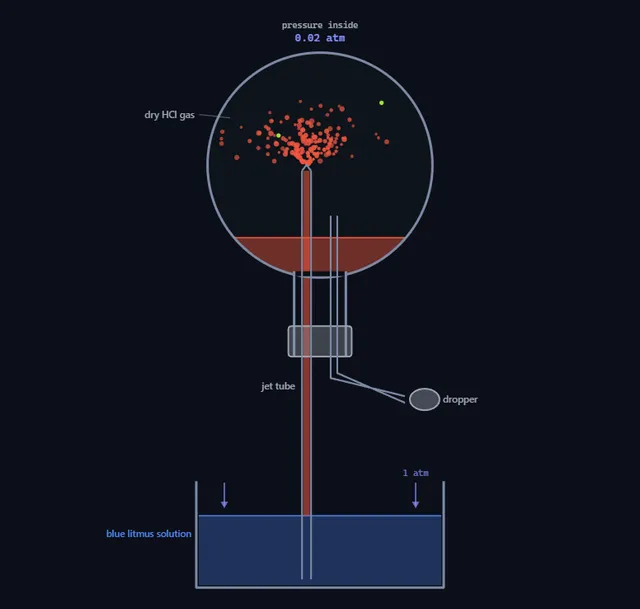
- In Scene 5, watch the inside bar drop to about 0.02 atm as the gas dissolves while the outside bar does not change.
- Compare Scene 6, where the fountain is colourless plain water, with Scene 7, where blue litmus turns red as it sprays into the flask.
- In Scene 8, switch 'Gas in the flask' to O₂, CO₂ and NH₃ and compare how far the liquid climbs, whether it turns red, and the outcome line at the top, such as 'CO₂: Liquid rises, then stalls'.
What to notice
- The first fountain uses colourless water, so on its own it can only show that the gas is very soluble; it says nothing about acidity.
- The second fountain repeats the experiment with blue litmus, and the change to red is the separate evidence that the solution is acidic.
- Before the dropper is squeezed, the pressures inside and outside are equal, which is why nothing moves until gas dissolves.
- Once the fountain runs, the leftover gas is squeezed into a smaller space and its pressure climbs back to 1 atm, so the flask fills almost completely and the flow stops.
The formulas
- Δp = p(outside) − p(inside)
- The pressure difference that drives the fountain: atmospheric pressure outside minus the reduced pressure left in the flask.
- p₁V₁ = p₂V₂
- Boyle's law: as liquid fills the flask, the remaining gas is compressed into a smaller volume and its pressure rises back towards 1 atm.
Questions
Why is the fountain experiment done once with plain water and once with litmus?
The two runs answer two separate questions. With colourless water, the fountain proves only that the gas dissolves enormously, because a soluble gas such as ammonia would give the same result. Adding blue litmus and seeing it turn red adds the second fact, that the solution is acidic. Scenes 6 and 7 of the walkthrough show the two runs one after the other.
What happens to the pressure inside the flask during the fountain experiment?
At the start the gas inside is at atmospheric pressure, so nothing moves. When a few drops of water dissolve most of the gas, the pressure inside falls sharply, to a small fraction of an atmosphere, while the air outside still presses at 1 atm. That difference pushes the liquid up the jet tube. Scene 5 shows the inside bar collapsing.
Why does the fountain stop before the flask is full?
Some gas is always left undissolved. As liquid pours in, that remaining gas is squeezed into a smaller and smaller space, and by Boyle's law its pressure rises. When it climbs back to atmospheric pressure there is no longer a pressure difference, so the flow stops. Because almost all of the HCl dissolved, the flask ends up nearly full.
Why does the litmus turn red only after it enters the flask?
Below the flask, the litmus solution in the trough contains no acid, so it stays blue. As it sprays into the flask it meets and dissolves hydrogen chloride, which ionises to give H₃O⁺ ions. Those ions turn blue litmus red. The colour change happens where the gas is, which is why the fountain appears red inside the flask in Scene 7.
Related simulations